What is Scrawl?
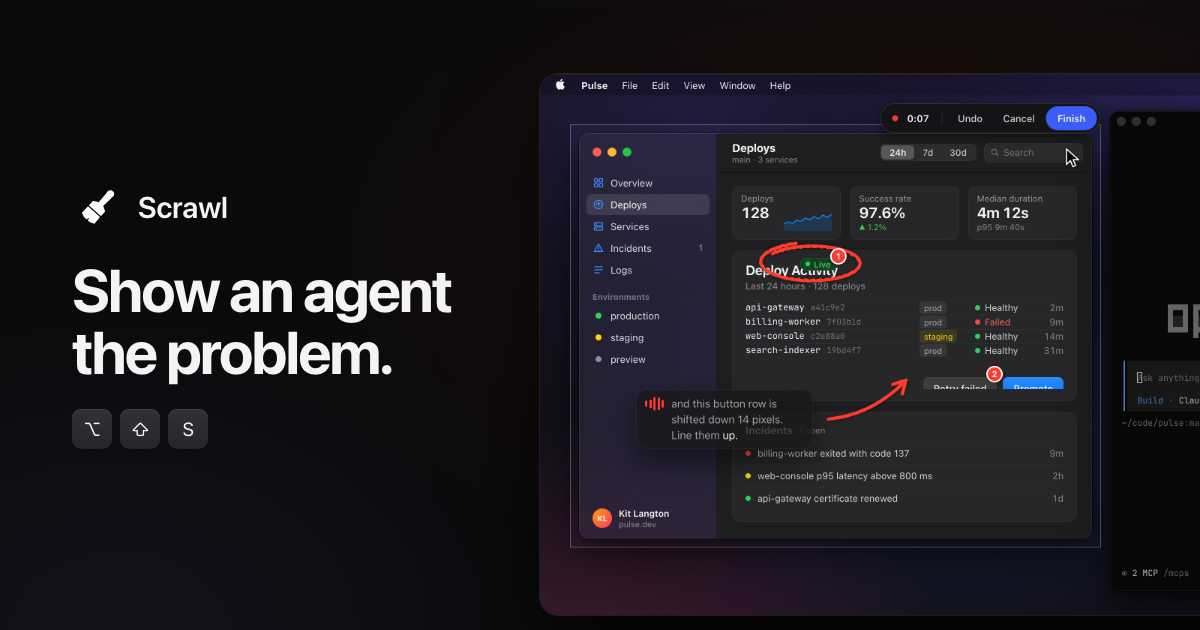
Scrawl is a Mac developer tool for showing coding agents a problem that is easier to demonstrate than describe. Press a shortcut to record the screen, talk through the issue, click around, and draw directly over what matters. Scrawl turns the capture into annotated keyframes, a time aligned transcript, an interaction timeline, and a structured manifest that can be copied or sent to an OpenCode session. It requires an Apple silicon Mac running macOS 26 or later.
Why Scrawl works
Describing a visual bug in text throws away the timing, screen state, cursor movement, and exact spot where something went wrong. Scrawl keeps that context by pairing narration and interaction data with selected annotated frames, then packaging the result for an agent. It gives the agent an annotated visual record instead of asking the developer to turn a moving bug into a paragraph.
Scrawl features
- Agent ready capture bundles. Each recording becomes a bundle with an annotated contact sheet, full resolution keyframes, a time aligned transcript and interaction timeline, and a structured JSON manifest.
- Draw while reproducing the problem. Hold Shift while recording to draw persistent red marks over the screen, while clicks and scrolling continue to reach the app underneath.
- Automatic OpenCode routing. Captures of local development sites can be routed to the project's active OpenCode session, with localhost projects matched through their port and working directory.
- Screen activity auto crop. Screen captures are cropped around the windows, clicks, marks, cursor activity, and changed regions that matter, while uncropped frames remain available in the bundle.
- iPhone capture. A cabled iPhone can be mirrored and recorded with Mac narration, annotations, interaction data, and native phone video included in the same capture workflow.
- On device transcription. Narration uses Apple's SpeechAnalyzer on macOS 26 by default, with word timings used to align transcript text and choose useful keyframes.
Who Scrawl is for
- Developers reproducing visual or interaction bugs who need to give a coding agent more context than a written issue can carry.
- OpenCode users working on local web apps who want a recorded problem routed directly to the project's active session.
- iOS developers debugging behavior on a physical iPhone who want narration, touches, marks, and phone video captured on the same timeline.
- App developers using ScrawlKit to add an in app recording flow that can send structured debugging context back to a Mac.
Similar micro SaaS ideas you can build
- Client feedback compiler for web agencies. A review tool where clients walk through a staging site and speak their changes while clicking and marking the screen. It turns the session into separate change requests with the relevant screenshot, spoken context, and page state attached to each one.
- Bug reproduction packets for QA teams. A testing tool that watches a tester reproduce an issue and converts the session into a compact handoff with key states, interaction order, annotations, and narration. Engineers get the evidence around the failure without scrubbing through a full recording.
- Workflow documentation from expert walkthroughs. A documentation tool for subject matter experts who explain an internal process by doing it on screen. It extracts the important stages, screenshots, and spoken explanation into a first draft of a step by step operating guide.