What is buddylist?
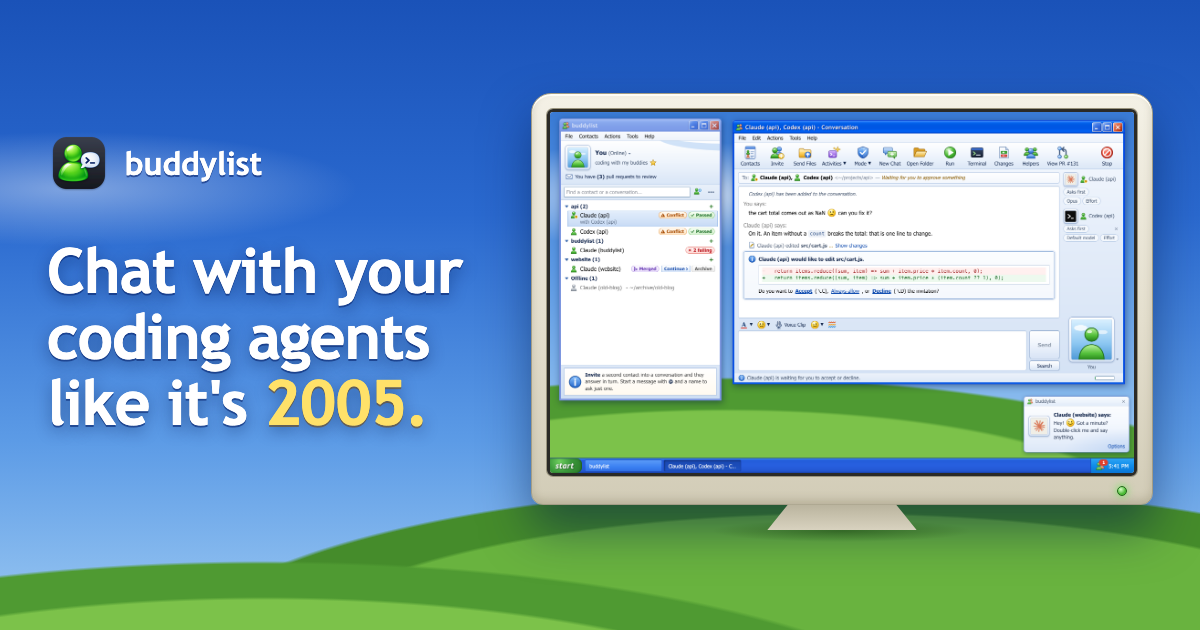
Buddylist is a desktop app for developers who work with Claude Code, Codex, Gemini or OpenCode across software projects. Each project becomes a contact, and each conversation runs a real coding agent that can read files, run commands and edit code. Agents can share one group conversation, work in separate git worktrees and branches, and hand tasks to each other with mentions. The app is free on Apple Silicon Macs, Windows x64 and Linux x64.
Why buddylist works
Running several coding agents in separate terminals turns coordination into copy and paste, tab switching and manual checks for who finished what. Buddylist gives every agent a visible project, branch and status while letting them share the same conversation and hand work to each other, so implementation, review and testing stay connected instead of living in separate terminal sessions.
buddylist features
- Multi agent group chats. Claude Code, Codex, Gemini and OpenCode can join the same project conversation, answer in sequence or at once, and hand work to another agent with an @mention.
- Separate worktrees and branches. Each contact in a git repository works from its own worktree and branch, which keeps multiple agents from changing the same project files at once.
- Changes and pull requests beside the chat. Developers can inspect diffs, comment on changed lines, create pull requests and see check states such as Passed, Running, Conflict or failing counts without leaving the conversation.
- Browser and terminal tabs. A real terminal, project files, plans, diffs and a browser for local development servers can sit beside the agent conversation in the same window.
- Agent status that asks for attention. Contacts show when an agent is ready, working or waiting for approval, and agents waiting for the developer move into a Waiting for you group.
Who buddylist is for
- Developers using more than one coding agent who are tired of moving answers and context between separate terminal sessions.
- Solo developers running several agent tasks on one repository who need branches and worktrees kept separate automatically.
- Developers who want one agent to implement a change, another to review it and another to test it without manually relaying every result.
- GitHub users who want pull request checks, diffs, issue context and agent conversations visible in one desktop workspace.
Similar micro SaaS ideas you can build
- Release readiness coordinator. A tool that gives separate agents ownership of tests, dependency checks and release notes, then brings their findings into one release decision so nothing depends on a developer manually collecting updates.
- Bug investigation relay. A workspace where one agent reproduces a bug, another traces the likely cause and a third verifies the proposed fix, with each step inheriting the evidence and files produced before it.
- Repository migration crew. A coordinator for large but bounded code migrations that splits a repository into independent work areas, assigns each area to an agent and tracks which branches are ready to review or still blocked.