What is Omnara?
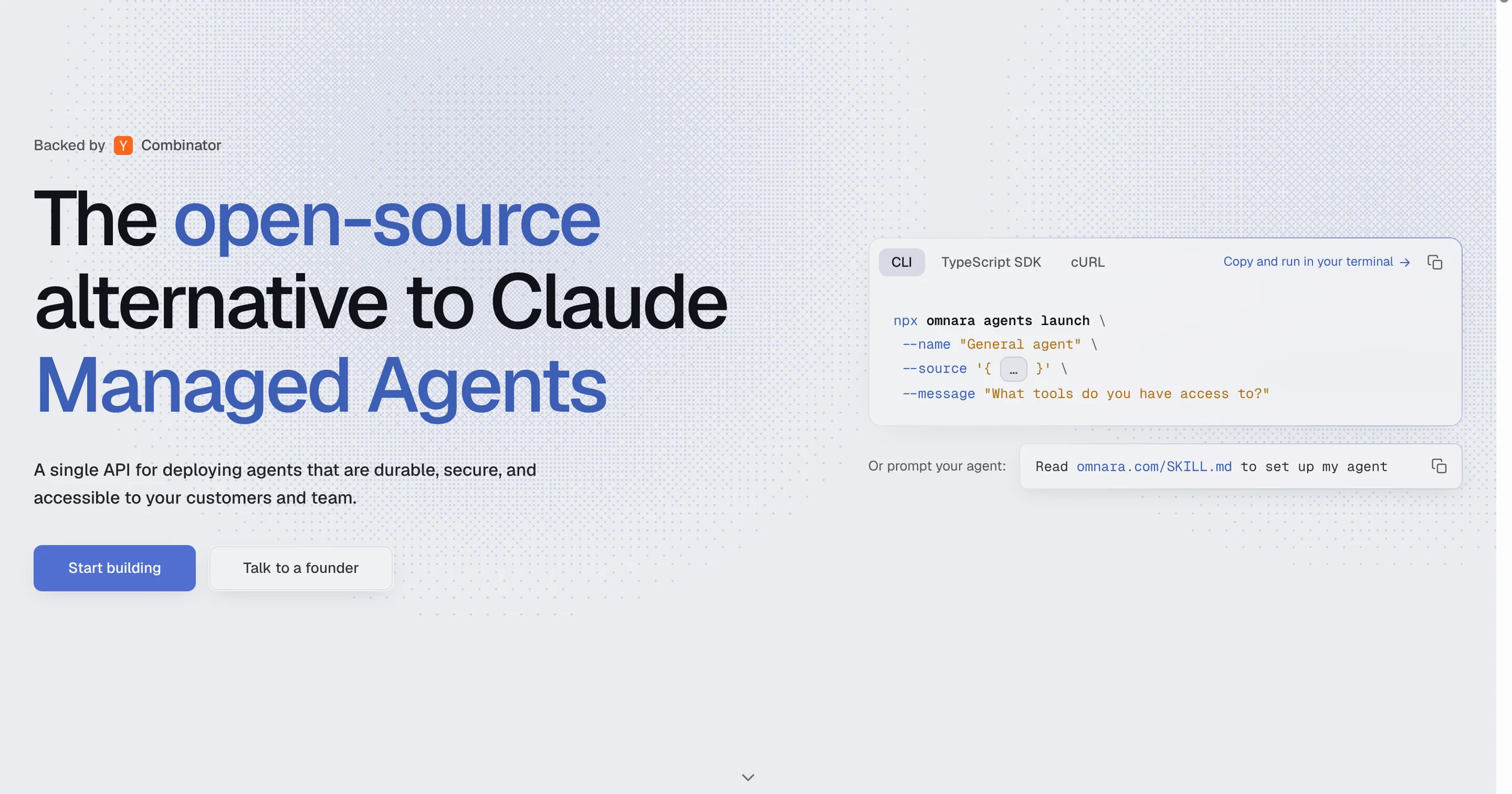
Omnara is an open-source agent execution platform that lets developers deploy durable AI agents accessible to customers and teams through a REST API and TypeScript SDK. Builders choose any compatible model, connect Omnara-managed sandboxes or their own machines, and configure encrypted, scoped secrets and approval policies so agents can act with the right access. Omnara runs in the cloud or self-hosted in a VPC under the Apache 2.0 license, with no platform fee and no per-seat charge.
Why Omnara works
Shipping an AI agent into a real product means solving execution state, machine provisioning, secret scoping, and approval flows before a single customer sees it. Omnara packages those layers under one API: durable state keeps long-running agents recoverable after failures or interruption, managed sandboxes give builders on-demand execution environments, encrypted secrets owned by organizations and granted to projects keep credentials isolated at the right scope, and built-in MCP and Slack integrations let agents reach existing tools through pre-built connectors rather than custom code.
Omnara features
- Durable agent state. Agents persist execution state so long-running workflows recover after a failure or interruption rather than starting from scratch.
- Managed sandboxes and connected machines. Builders attach Omnara-managed sandboxes or bring their own machines; idle managed machines auto-sleep to keep costs proportional to actual usage.
- Scoped secrets and approval policies. Organizations hold encrypted secrets and grant access to specific projects so each agent runs with only the credentials it needs; configurable approval gates require human sign-off on specific tool calls, with an audit history per policy decision.
- Bring-your-own model support. Any compatible model can be wired into an agent; developers supply their own API keys and configure the model per agent rather than routing through a single provider.
- MCP and Slack integrations. Agents connect to MCP tool servers and Slack natively, so builders can wire agents into internal bots or product workflows using pre-built connectors.
- REST API, TypeScript SDK, CLI, and dashboard. Four entry points cover the same agent control plane, so teams can automate provisioning from code, script agent management from the terminal, or configure projects from the browser.
Who Omnara is for
- Backend developers building customer-facing AI agents who need durable execution and tool-call approvals without managing their own agent runtime.
- Platform teams shipping internal Slack bots or code review agents who want a shared control plane with scoped secrets and audit history per project.
- AI product builders who need to embed agents in a product dashboard and expose them to end users with configurable access controls.
- Founders evaluating self-hosted agent infrastructure who want Apache 2.0 licensing and the option to run in their own VPC.
Similar micro SaaS ideas you can build
- Approval workflow API for AI actions. A hosted approval layer that routes specific agent actions (file writes, API calls, payments) to human reviewers through a configurable policy engine, with an audit log and webhook notifications. Teams building autonomous agents in sensitive domains pay a monthly fee for the review queue and policy management interface.
- Agent usage metering and billing API. An infrastructure API for SaaS builders that tracks per-agent, per-user, or per-tool-call consumption, enforces usage limits, and generates invoices so teams can sell agent capacity to customers without building a billing system. Monetizes as a percentage of billed usage or a flat monthly fee per connected tenant.
- Sandbox registry for agent tools. A registry where developers publish preconfigured container definitions optimized for common agent tasks such as web browsing, code execution, and document processing, with versioned environments teams can pull by name. Targets AI product teams that need reproducible, auditable execution environments without maintaining custom images.