What is Worklytics?
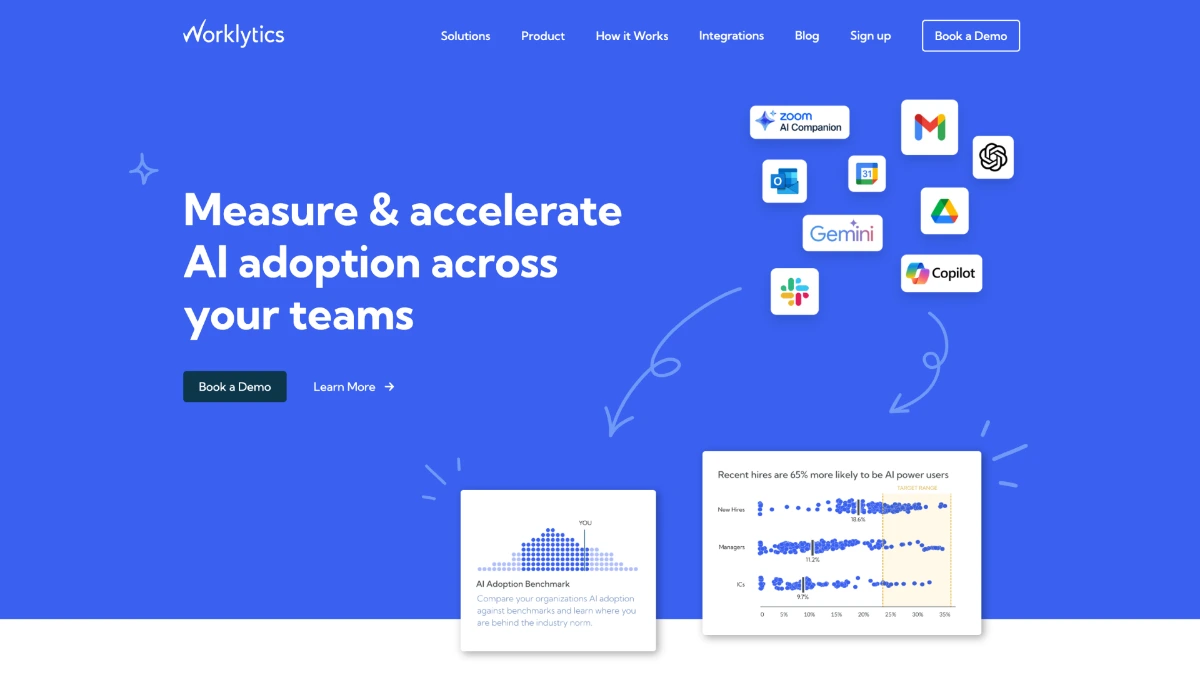
Worklytics is a workplace analytics platform that helps people leaders measure collaboration, meetings, and AI adoption using anonymized data from existing tools. The page lists 200 plus designed metrics, integrations with systems like Microsoft 365 and Google Workspace described in the product summary, and a privacy posture covering pseudonymization, group-level aggregation, GDPR, and CCPA. Named customers on the page include Uber, Asana, Pinterest, Panasonic, and Telefonica.
Why Worklytics works
HR and engineering leaders are asked to improve productivity and AI adoption without invading employee privacy, and most analytics tools either read message content or fail to anonymize properly. Worklytics works only on metadata signals like meeting frequency and response times, then aggregates them at the group level, which lets leaders compare patterns without reading anyone's messages.
Worklytics features
- 200 plus collaboration metrics. A library of curated metrics models how work happens across industries so analytics teams do not start from scratch on every question.
- AI adoption monitoring. Tracks how teams are using AI tools so leaders can identify pockets of high or low adoption and plan rollout support.
- Meeting effectiveness analytics. Surfaces meeting frequency and structure so leaders can act on meeting overload as a measurable problem.
- Organizational network analysis. Maps cross-team interactions and surfaces silos so leaders can target communication gaps.
- Privacy-first data pipeline. Uses pseudonymization and group aggregation, with no content analysis and no browser monitoring, so the system passes employee privacy reviews.
- Benchmarking. Lets organizations compare their patterns against industry baselines rather than guessing what good looks like.
Who Worklytics is for
- People analytics teams at large enterprises measuring engagement and burnout without reading employee messages.
- IT and CIO offices rolling out Copilot or other AI tools who need adoption data per business unit to target enablement.
- Engineering leaders at multi-product orgs studying cross-team collaboration patterns before reorganizing.
- HR leaders evaluating hybrid and remote work policy effectiveness using meeting and response-time signals.
- Real estate and workplace teams sizing office demand based on actual in-office collaboration patterns.
Similar micro SaaS ideas you can build
- AI adoption coach for managers. A tool that surfaces team-level Copilot or ChatGPT usage and suggests targeted enablement nudges, sold per manager.
- Meeting-load coach. A SaaS that flags overloaded calendars and suggests cancellations across a team, billed per leader.
- Engineering effectiveness dashboard. An analytics product for VPs of Engineering that combines collaboration metadata with delivery metrics from Jira and GitHub, sold per organization.