What is Panoply?
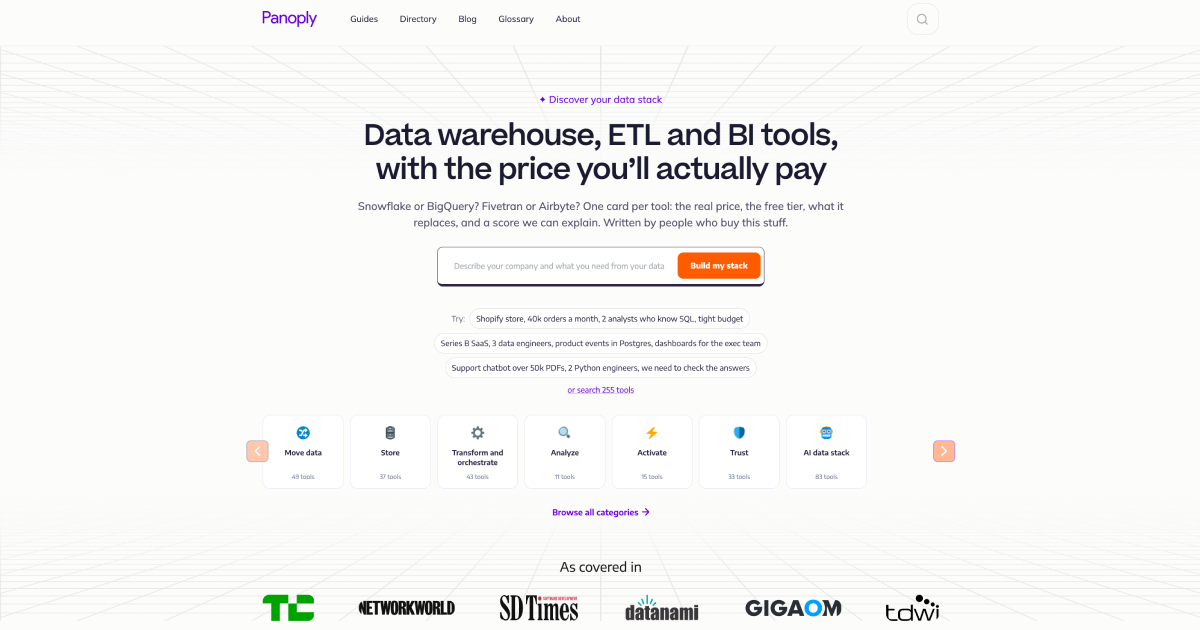
Panoply is an independent directory for teams choosing tools for a modern data or AI stack. It covers warehouses, ingestion, transformation, orchestration, BI, reverse ETL, observability, catalogs, and AI infrastructure. Each tool page brings together real pricing, free options, deployment, buyer fit, and a Panoply Score, with pricing checked against the vendor's own page.
Why Panoply works
Software comparisons become weak when prices are hidden, evidence is mixed with opinion, and vendors can influence how they appear. Panoply checks facts against primary sources and exposes the inputs behind each score, so buyers compare measurable cost, adoption, openness, and fit instead of trusting a polished vendor pitch.
Panoply features
- Verified pricing. Tool pages show pricing and free options checked against the vendor's own pricing page on a stated date.
- Explainable scoring. The Panoply Score rates each tool across pricing honesty, adoption evidence, momentum, openness and exit, practitioner sentiment, and an editorial verdict.
- Buyer fit on every card. Directory cards describe who a tool is best for, alongside deployment, open source status, pricing, and free access.
- Visible evidence. Each score component has a stated reason, and inputs that cannot be measured are marked not applicable rather than treated as failures.
- Price change checks. Public signals are refreshed monthly, while prices are checked again when a vendor changes its pricing page.
Who Panoply is for
- Data leaders narrowing a long list of warehouses, ingestion tools, BI products, or orchestration frameworks before committing engineering time.
- Engineering teams comparing open source and commercial infrastructure where deployment, pricing, and the difficulty of leaving matter alongside features.
- Startup founders building a data or AI stack who need to understand the free entry point and real billing model before choosing vendors.
- Tool vendors checking whether their pricing, integrations, deployment options, and other factual details are represented correctly.
Similar micro SaaS ideas you can build
- SaaS pricing change monitor. A procurement tool that watches the pricing pages of shortlisted software and records changes to plans, billing units, and free access. Buyers get a dated before and after record instead of discovering a new cost during renewal.
- Vendor exit risk report. A decision tool for engineering leaders that turns self hosting, open formats, licensing, and migration difficulty into an evidence backed exit report before a team adopts infrastructure. It helps buyers judge how hard a future switch could be, not just how attractive the tool looks today.
- Shortlist evidence pack. A research app for small procurement teams that turns a handful of vendor candidates into one normalized decision memo. Each claim keeps its source, pricing gets a checked date, missing evidence stays visibly missing, and the final recommendation separates measured facts from human judgment.