What is StarOps?
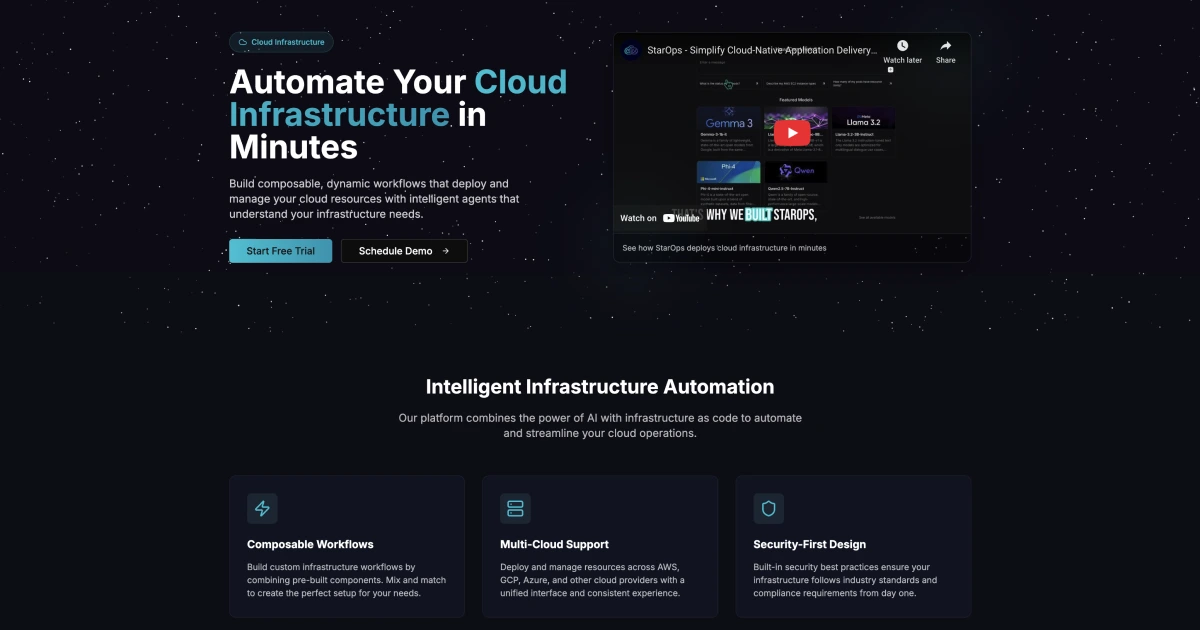
StarOps by Ingenimax is a cloud DevOps platform that lets engineers provision and operate infrastructure through natural language prompts and AI agents. It runs as a web app in beta, with an agent control plane that monitors agents, models, and tools across AWS, GCP, Oracle Cloud, Kubernetes, and Terraform. Platform and DevOps teams use it to ship cloud and AI workloads without writing every config file by hand.
Why StarOps works
Most cloud changes still mean stitching together Terraform, dashboards, runbooks, and ticket queues before anything ships. StarOps turns that loop into a prompt plus a reviewable code change, with read-only defaults so an agent cannot touch production until a human approves the upgrade path. That cuts the gap between an idea and an applied IaC commit, which is where most cloud delivery time leaks today.
StarOps features
- Prompt-driven provisioning. Engineers describe the resource they need and StarOps drafts the provider calls so they skip hand-writing the same Terraform skeletons each sprint.
- Agentic troubleshooting. Agents collect logs, metrics, and events from the affected service so on-call engineers reach a probable root cause without context-switching between five tools.
- Agent control plane. A single dashboard tracks every agent, model, and tool in use so teams can audit what an agent did before it touched a cluster.
- Infrastructure as code generation. StarOps emits IaC changes through a code review workflow so the same pull request gating that protects app code now protects infra.
- Read-only by default. New connections start in observe mode and only unlock write access when a human upgrades the role, lowering the blast radius during evaluation.
Who StarOps is for
- Platform engineers at small SaaS companies who are the only person who knows the Terraform layout and want an agent to handle routine ticket-driven changes.
- Founding engineers shipping AI products who need GPU infra and observability stood up but cannot afford a dedicated DevOps hire.
- Site reliability teams handling multi-cloud footprints who want one console to investigate incidents across AWS, GCP, and Kubernetes instead of swivel-chairing dashboards.
- Consultancies running cloud migrations who want a repeatable agent workflow they can hand to client teams once the engagement ends.
Similar micro SaaS ideas you can build
- Migration copilot for monoliths. Tool for staff engineers porting legacy services to Kubernetes, scoping the migration into reviewable diffs with rollback notes, sold per repository to mid-market engineering orgs.
- Cost-aware IaC reviewer. Service for FinOps leads at growth-stage SaaS companies that flags expensive provider patterns inside Terraform pull requests, billed per protected repo.
- AI workload deployment hub. Platform for ML teams that packages a model, its inference service, and observability into one approval workflow, priced per deployed endpoint.
- On-call triage agent. Assistant for SRE teams that gathers logs, traces, and recent deploys when an alert fires and proposes the first runbook step, sold per protected service.