What is Autom?
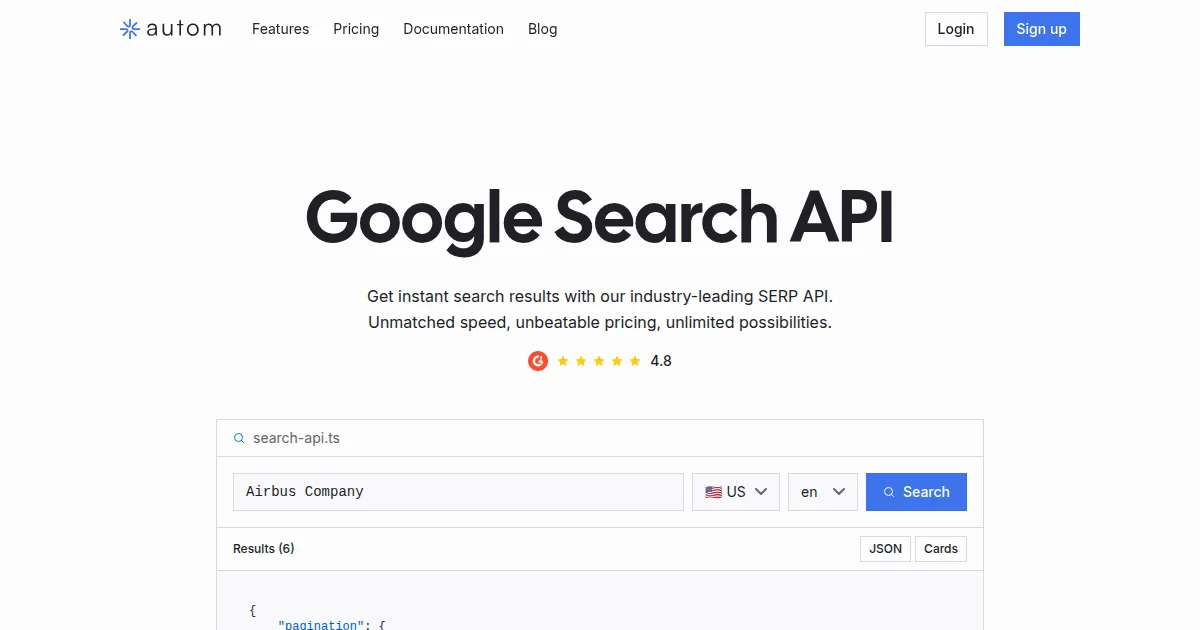
Autom is a SERP API that returns structured JSON search results from Google, Bing, Brave, and Perplexity without requiring developers to build or maintain scrapers. A single API key unlocks endpoints for web search, news, images, shopping, jobs, maps, and autocomplete, each returning real-time data with location and language parameters. Failed requests are free, and credits are valid for one year, making it straightforward to budget for variable search workloads.
Why Autom works
Building a scraper for Google means dealing with CAPTCHA challenges and markup changes that break parsers without warning. Autom sits in front of that complexity and returns clean JSON from a stable endpoint, so developers ship features instead of maintaining infrastructure. Because every response is live and uncached, the data is accurate enough for SEO rank tracking, price monitoring, and AI training datasets where stale results would produce wrong answers.
Autom features
- Multi-engine coverage. One API key queries Google, Bing, Brave, and Perplexity so teams consolidate providers and reduce integration overhead.
- Granular location targeting. Set country, language, city, or neighborhood per request so rank tracking and local SEO tools return results from the exact geography that matters.
- Broad endpoint library. Endpoints cover Google Search, News, Images, Shopping, Jobs, Maps, Videos, Autocomplete, and a lightweight Search Light variant, so one integration covers most search data needs.
- Pay-per-success billing. Only HTTP 200 responses consume credits, so failed or timed-out requests cost nothing and budgets reflect actual useful data received.
- MCP client support. Autom connects to Claude Code, Cursor, Gemini CLI, and OpenAI Developer Mode via MCP, letting AI coding tools query live search results directly from the editor.
- Dashboard with analytics. The app includes per-endpoint and per-key consumption charts, request logs for debugging, a playground for testing queries, auto top-up, and team member invites.
Who Autom is for
- SEO professionals: track organic rankings, local pack results, and SERP features across keywords, countries, and languages without managing scraper infrastructure.
- AI and ML engineers: collect labeled search result datasets and access knowledge graph and direct answer fields in JSON for training and fine-tuning pipelines.
- Price and travel monitoring teams: pull e-commerce pricing, flight, and hotel search results at scale to power comparison tools and alerting systems.
- News and compliance teams: monitor brand mentions, news trends, and background check data across search engines, with use cases noted for banks, law firms, and law enforcement.
- Indie developers and agencies: get 1,000 free requests on signup and pay-as-you-go credits with no contracts, making it practical to prototype and scale search-dependent features without upfront commitment.
Similar micro SaaS ideas you can build
- Local rank tracker. Local businesses and SEO agencies; pull Google Search and Maps results by city for target keywords on a daily schedule and display rank movement over time; agencies pay monthly per client location monitored.
- News alert pipeline. Brand managers and PR teams; query Google News for brand and competitor keywords on a cron schedule, deduplicate results, and push new stories to Slack or email; teams pay to avoid missing coverage in real time.
- E-commerce price monitor. Retailers and marketplace sellers; query Google Shopping for competitor product listings on a schedule and alert when prices drop below a threshold; merchants pay to protect margin without manual checks.
- SERP dataset builder. AI teams and researchers; run bulk keyword lists through the API and export structured result sets as training data for ranking models or search quality classifiers; teams pay per dataset generation run.
- Autocomplete keyword tool. Content strategists and SEO writers; query Google Search Autocomplete for seed keywords and surface long-tail suggestions organized by topic cluster; individual users pay for a quota of daily keyword pulls.